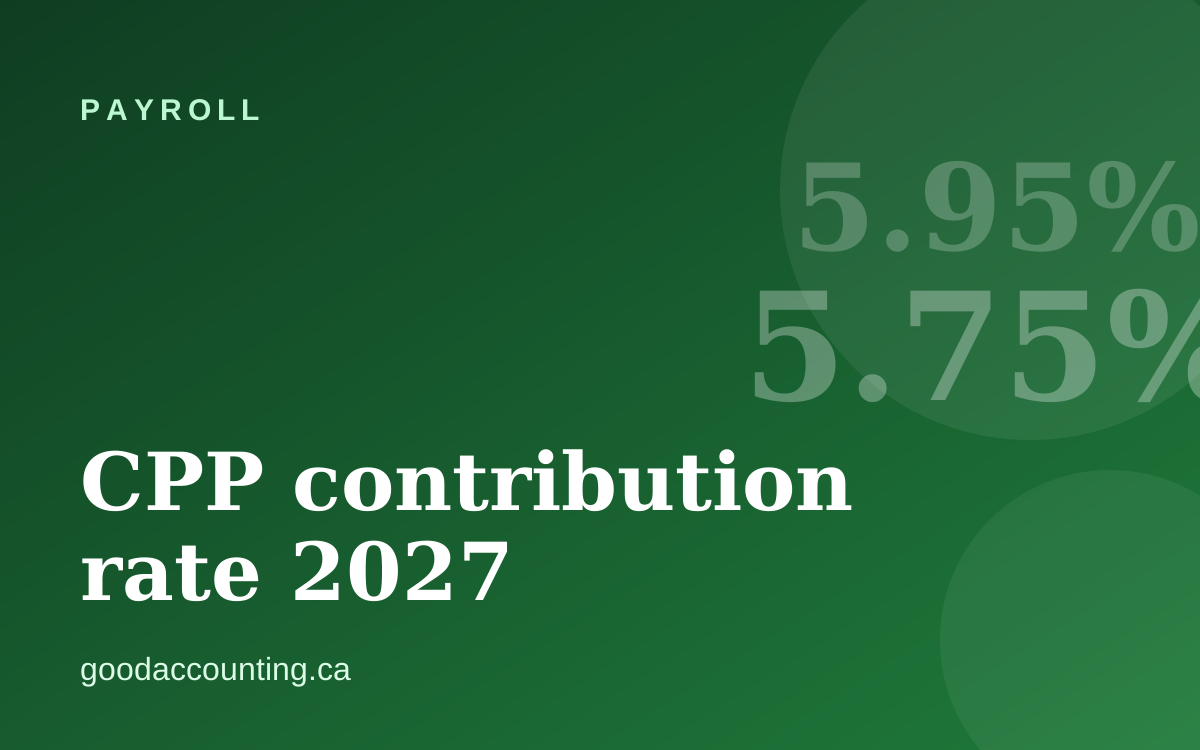
The Canada Pension Plan (CPP) contribution rate is dropping in 2027. Starting January 1, 2027, employees and employers will contribute 5.75% instead of 5.95%, leaving workers with slightly more money in their paycheques and reducing payroll costs for businesses.
The good news? Your CPP retirement pension benefits will not be reduced because of this change.
Whether you're an employee checking your CPP deductions, a self-employed professional calculating contributions, or an employer managing payroll, here's what the 2027 CPP contribution rate means for you.
Employers preparing for the 2027 CPP rate changes can explore payroll services for small businesses to manage employee deductions, CPP contributions and CRA remittances.
CPP contribution rate 2027 vs. 2026: what's changing?
The 2027 CPP rate reduction was introduced through Bill C-30, which received Royal Assent in June 2026. It lowers the base CPP contribution rate while keeping the additional CPP enhancement rates unchanged.
Here's how the CPP contribution rates in 2026 and 2027 compare:
| CPP contribution type | 2026 | 2027 |
|---|---|---|
| Base CPP — employee | 4.95% | 4.75% |
| Base CPP — employer | 4.95% | 4.75% |
| First additional CPP — employee | 1.00% | 1.00% |
| Total regular CPP — employee | 5.95% | 5.75% |
| Total regular CPP — employer | 5.95% | 5.75% |
| Self-employed combined rate | 11.90% | 11.50% |
| CPP2 — employee/employer | 4.00% | 4.00% |
The reduction is 0.20 percentage points each for employees and employers. Self-employed Canadians, who generally pay both portions, receive a combined reduction of 0.40 percentage points.
For a closer look at the previous year's rules, see CPP contribution rates and limits for 2026.
How to calculate CPP1 (first-tier contributions)
- Subtract the basic exemption: take your gross pensionable earnings for the pay period or year and subtract the prorated or annual basic exemption ($3,500). Earnings below $3,500 per year are exempt from CPP.
- Multiply by the contribution rate: multiply the result by 5.95% (0.0595) for 2026, or 5.75% (0.0575) for 2027.
- Apply the maximum limit: stop deducting or contributing once you reach the maximum annual contribution. For 2026 that's $4,230.45 (or $8,460.90 if self-employed).
Calculation example (full-year employee in 2026)
- Annual gross salary: $60,000
- Minus basic exemption: $60,000 − $3,500 = $56,500 (contributory earnings)
- Multiply by rate: $56,500 × 5.95% = $3,361.75 (employee contribution)
- The employer matches this exact amount ($3,361.75)
Run the same $60,000 salary at the 2027 rate and the employee contribution drops to $3,248.75 ($56,500 × 5.75%), with the employer matching it.
Does CPP2 change in 2027?
No. The CPP2 contribution rate remains 4% each for employees and employers.
CPP2 applies to pensionable earnings between the YMPE and the higher Year's Additional Maximum Pensionable Earnings (YAMPE). Although the rate remains unchanged, the earnings thresholds are adjusted annually.
Businesses should ensure that CPP deductions are accurately reflected in their accounts. Reliable bookkeeping services for small businesses can help track employee wages, employer contributions and payroll expenses.
What is the maximum CPP contribution for 2027?
The maximum CPP contribution in 2027 depends on the pensionable earnings limits published by the CRA.
For 2026, the Year's Maximum Pensionable Earnings was $74,600, and the maximum regular employee CPP contribution was $4,230.45.
As of October 13, 2026, the CRA had not yet published the final 2027 YMPE and YAMPE figures. The new contribution rate is confirmed, but the maximum dollar amounts will depend on those updated thresholds.
Will lower CPP contributions affect your retirement benefits?
No. The CPP rate reduction does not change how retirement pension benefits are calculated.
The federal government introduced the lower rate following a review of CPP's long-term financial sustainability. The reduction changes how much workers contribute, not the established retirement benefit formula.
Your actual CPP pension continues to depend on your contribution history, pensionable earnings and the age you begin receiving benefits.
For people approaching retirement, CPP income may also affect broader tax planning. Personal income tax filing services can help with the reporting of pension income and other taxable income.
What does the 2027 CPP rate mean for employers?
Lower CPP contributions also mean slightly lower employer payroll expenses.
For example, a business with 20 employees each earning $60,000 could save approximately $2,260 annually in employer CPP contributions, assuming unchanged eligible earnings.
Employers should prepare before their first 2027 payroll by checking contribution rates, updated earnings ceilings and CRA remittance requirements.
See how you can set up payroll for your employees with the new CPP contribution rates in 2027, including employee deductions, employer contributions, CPP2 calculations and CRA payroll remittances.
Businesses should also review CRA payroll remittance and T4 filing deadlines to ensure contributions are reported and paid on time.
Using cloud accounting software and payroll recordkeeping services can help keep payroll information organized throughout the year.
How does the 2027 CPP rate affect self-employed Canadians?
Self-employed Canadians generally pay both the employee and employer portions of CPP on eligible net self-employment earnings. Their combined regular rate decreases from 11.90% to 11.50% in 2027.
For example, a self-employed individual with $60,000 in eligible pensionable earnings would save approximately $226 annually from the contribution rate change alone.
Freelancers and sole proprietors can explore self-employed income tax filing and CPP contribution support. They can also review common self-employed tax deductions in Canada to better understand their wider business tax obligations.
For incorporated business owners, salary generally attracts CPP contributions while dividends generally do not. This makes compensation planning important when reviewing corporate taxes.
The article on salary versus dividends for Ontario business owners explains the main considerations, while a corporate tax accountant for small businesses can assist with related corporate tax filing requirements.
Where can you get help with CPP payroll contributions in Ontario?
Good Accounting is an accounting-services marketing platform connecting individuals and businesses with listed accountants, bookkeepers and tax preparers across Ontario. With the CPP contribution rate changing in 2027, employers can find support for payroll setup, employee CPP deductions, CRA remittances and payroll recordkeeping.
Businesses looking for local support can explore payroll processing services in Toronto, CPP and EI payroll support in Mississauga, and small business payroll services in Brampton. Employers in Markham and Vaughan can also find local payroll service listings for employee deductions and remittances.
FAQ
What is the CPP contribution rate for 2027 in Canada?
The regular CPP contribution rate is 5.75% each for employees and employers, down from 5.95% in 2026.
Is CPP going down in 2027?
Yes. The regular employee and employer CPP contribution rates decrease by 0.20 percentage points starting January 1, 2027.
How much CPP will be deducted from a $60,000 salary in 2027?
Approximately $3,248.75 annually using the simplified calculation, assuming all $60,000 is eligible pensionable income below the annual maximum.
What is the maximum CPP contribution for 2027?
The exact maximum depends on the 2027 pensionable earnings limits, which had not yet been announced as of October 13, 2026.
Is CPP2 also decreasing in 2027?
No. CPP2 remains at 4% each for employees and employers, with updated annual earnings thresholds.
What is the self-employed CPP rate for 2027?
The combined regular contribution rate is 11.50%, excluding applicable CPP2 contributions.
Will the lower CPP contribution rate reduce retirement benefits?
No. The rate reduction does not change the existing CPP retirement pension formula.
Sources
- Office of the Chief Actuary - 33rd CPP Actuarial Report
- Canada Revenue Agency - CPP Contribution Rates, Maximums and Exemptions
- Canada Revenue Agency - CPP and CPP Enhancement
- Government of Canada - Canada Pension Plan Act
Disclaimer: This article is for general informational purposes only and does not constitute professional accounting, tax, or financial advice. Every business situation is different, and tax laws can change. Please consult a licensed accountant in Brampton or the GTA before making any financial or tax decisions based on this content. Good Accounting is a marketing platform that lists payroll and bookkeeping professionals; it is not an accounting firm.
Related service: learn how we can help.